
Chemistry Education and STEM
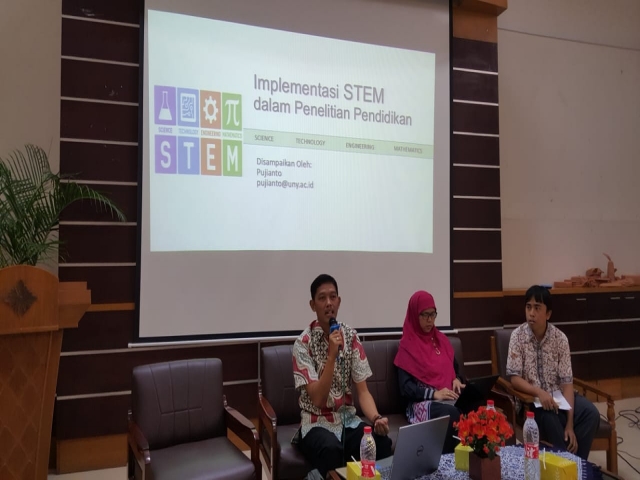
The public lecture held on Tuesday, 2 April 2019, was attended by students of the Chemistry Education study programme. The event began at 08.30 WIB, with the speakers Dr. Pujianto, S.Pd., M.Pd. and Dr. Antuni Wiyarsi, S.Pd.Si., M.Sc., moderated by Mr. Muhammad Zamhari, M.Sc.
The material delivered was the application of STEM-based research in facing the industrial revolution 4.0 era. The first speaker to give a presentation was Dr. Pujianto, S.Pd., M.Pd. In his presentation he explained what the concept of STEM actually is, what STEM really is, and how it is applied in education. He also explained that STEM has in fact existed for a long time, but its development has not been widespread, so that society has become unfamiliar with this material.
In his explanation he said that STEM is essentially a technological engineering that fuses several educational disciplines to solve a problem; the educational disciplines included here are science, technology, engineering, and mathematics. He also explained how these educational disciplines support one another in STEM. For example, science in STEM can help learners understand something that is a problem, technology helps learners innovate to overcome the problem, engineering helps in building a system and modifying the system in order to solve the problem, and mathematics is used to express everything with number symbols so that it can be calculated, making problem solving easier.
In the STEM method he emphasised that this system is oriented not only towards understanding theory but also towards results, that is, not only mastering theory but also how learners are able to produce a product from that theory. With the STEM method, learners are expected to develop their ways of thinking critically, creatively, ingeniously, and imaginatively, as well as an ability to solve many problems. To make its application more effective in education, it is advisable for teachers to connect a topic with a problem that often occurs in everyday life and to create integrated project-based learning experiences so that students understand the material better.
He also taught how to apply STEM to learners at various levels of STEM. Besides applying a system of critical, creative, ingenious, and imaginative thinking, he also emphasised that STEM applies a survival system in everything, meaning that this ability can be practised throughout life.
Then in the second session, the second speaker, Dr. Antuni Wiyarsi, S.Pd.Si., M.Sc., said that applying STEM in university courses is very important to start teaching and practising, because the changing times demand that we always be ready to face every change, and the STEM method is considered usable in facing those changes.
She explained that the changes in the chemistry education curriculum in the 4.0 era need to be addressed by also strengthening our grounding in chemistry education material, and STEM learning can be used to deal with this problem so that students can think critically and creatively. Besides being suitable for facing the changing times, she emphasised that STEM is also useful for preparing a person to become a lifelong learner, and she said that STEM can be used in various data analysis instruments.
In addition, she also described several aims of STEM, namely STEM-based assessment, problem solving that produces a product, and that the STEM method leans more towards in-depth application.
So, after the presentation sessions ended, it can be concluded that the STEM method is suitable for application in chemistry education because, besides preparing teachers to become creative, critical-thinking, and competent instructors, this method is also able to prepare learners to become lifelong learners. This ability is useful throughout life.
Comments (0)
No comments yet.