
Understanding the Importance of Early Childhood Education for Children's Growth and Development
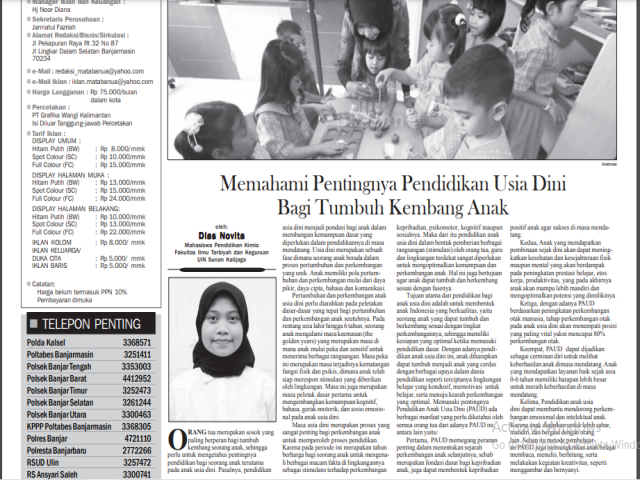
Parents are the figures who play the greatest role in a child's growth and development, so they need to understand the importance of education for a child, especially in early childhood. Early childhood education is the foundation on which children build the basic abilities they will need in their future education. Early childhood is a phase in which a child is in a unique process of growth and development. Children have patterns of growth and development that range from thinking ability and creativity to language and communication.
The growth and development of young children needs to be directed towards laying the right foundations for the whole development of the child. From birth to the age of 6, a child goes through a golden age (the golden years), a period in which the child begins to be receptive and sensitive to a wide range of stimuli. This sensitive period is a time of maturation of physical and psychological functions, when the child is ready to respond to the stimulation provided by the environment. It is also the first period in which the foundations are laid for developing cognitive, language, motor and socio-emotional abilities in early childhood.
Early childhood is a very important period for a child's development in obtaining an education. This period is a precious time for a child to recognise the many kinds of facts in their surroundings as stimuli for the development of their personality, psychomotor, cognitive and social abilities. Therefore, early childhood education in the form of various kinds of stimulation provided by parents, teachers and the immediate environment is essential to optimise the child's abilities and development. It also aims to ensure that children grow and develop according to their stage.
The main goal of education for young children is to shape quality Indonesian children, that is, children who can grow and develop according to their level of development so that they are optimally prepared when they enter primary education. With early childhood education, children are expected to grow into intelligent children through various efforts in the world of education, such as creating a conducive learning environment, motivating them to learn, and moving towards optimal development. In recognising the importance of Early Childhood Education (PAUD), there are various benefits of PAUD that all parents need to know, among them:
First, PAUD plays an important role in determining the course of a child's later development, because it is the basic foundation of the child's personality and can also shape a positive personality so that the child succeeds in the future.
Second, Children who receive guidance from an early age can improve their physical and mental health and well-being, which will have an impact on better learning achievement, work ethic and productivity, so that in the end the child will be more independent and able to optimise their potential.
Third, with PAUD, based on the development of the human brain, the stage of brain development in early childhood occupies the most vital position, reaching 80% of brain development.
Fourth, PAUD can be used as a mirror for seeing the child's success in the future. Children who receive good services from the age of 0-6 years have a greater chance of achieving success in the future.
Fifth, Early childhood education can help encourage children's emotional and intellectual development. This is because children are taught to be more patient, independent, and to get along with others. In addition, PAUD learning methods also allow children to learn to read, write and count, and to take part in creative activities such as drawing and singing.
https://matabanua.co.id/2023/06/14/kain-sasirangan-resmi-miliki-hak-kik/
Comments (0)
No comments yet.