
Technology in Education: Progress or Burden?
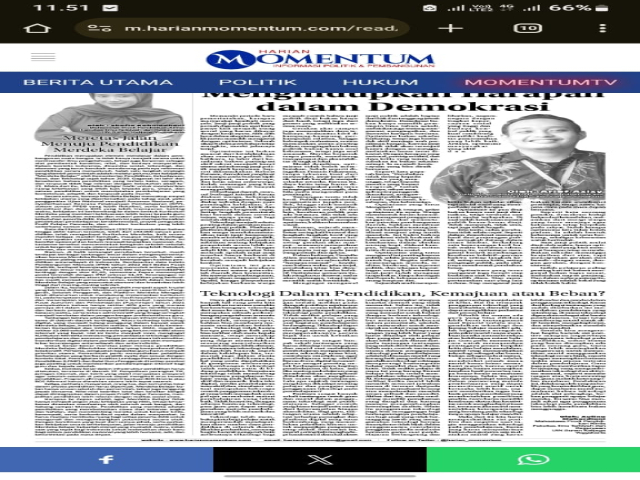
Technology in Education: Progress or Burden?
By: Aulina Mahardiani
In today’s era of globalisation there are many things we need to pay attention to, especially the ever-growing development of technology from one period to the next. Technology is a development of human knowledge designed to make life easier, faster, and even to help humans carry on their lives. Technology is not only physical devices that can be seen with the naked eye, but includes systems, processes, and ideas that make it easier for a person to solve problems more efficiently.
Technological progress has changed many aspects of our lives, including the world of education. Therefore, one thing that needs attention amid the onslaught of rapidly advancing technology is the field of education. Technological progress has driven the creation of a far more interactive and engaging learning experience. Digital textbooks, interactive learning media, and virtual simulators are some examples of technology use that have helped learners understand learning material better. Not only that, with the help of technology, teachers can also use more engaging and interactive learning methods.
Technology has opened the door for learners to gain easier access to educational resources all over the world. If we look closely, the rapid rise of technology does have many good effects on education, but we should not look only at its positive impact, because behind it all there are just as many negative impacts of technology on education. Quite a few learners are distracted by the use of technology while learning activities are under way. Technology can have a negative impact on students who do not use it wisely and for the common good.
Of course, there are very many challenges that teachers and students must face when learning with present-day technology, for example the smartphone, so that learning remains effective. Because in this digital era the smartphone is very important for classroom learning to take place. So if a lesson that requires smartphones is cancelled, it will hinder the learning. So what challenges must learners and teachers face when using technology in learning?
There are certainly very many challenges for teachers and students in using technology during learning. A common example ranges from skills to accessibility. For teachers, the main challenge is adapting to digital devices and platforms that keep evolving, which requires special training to ensure that teaching remains effective. Meanwhile, students often face obstacles in terms of access to devices or inadequate internet connections. In addition, not all students have sufficient digital literacy to learn with technology. These challenges call for collaboration among the government, schools, and the community to create inclusive solutions.
However, there are some heavier challenges that learners and teachers must face, which may be harder to overcome than the challenges mentioned above. One example of a main challenge in using technology in learning is students’ poor habit of relying too much on technology, which reduces their ability to learn independently and think critically. Not a few learners today lack learning literacy because they rely too much on technology in the form of AI. This dependence is often seen when students prefer to look for instant answers on the internet rather than trying to understand concepts or solve problems on their own and independently. As a result, they tend to have a shallow understanding and are less able to develop analytical skills. In addition, the use of technology can also disrupt learning for irresponsible children who use technology such as smartphones unwisely, for example using social media or playing games while learning is under way and while the teacher is explaining in class. This is a use of technology that causes distraction, which can divert attention from the learning process
Behind all of that, for teachers, an arguably bigger challenge when students rely too much on technology and do too little independent learning is how to change students’ mindset without making them feel pressured or lose interest in learning. Teachers need to find ways to instil the importance of critical thinking and deep learning, while still using technology as an aid, not as an instant solution.
Another difficulty is detecting to what extent students truly understand the material, because students may simply present answers from a search without really understanding the concept. In addition, teachers also face the challenge of designing learning methods that can motivate students to try harder, such as giving project-based assignments or discussions that require analytical thinking. Teachers must have extra patience and creativity to deal with this situation, especially if students show repeated dependence on technology without any effort at independent learning.
Therefore, we must pay attention to both the positive and negative sides when we want to use technology in learning. Because it is not only teachers who must be aware of this, but students who must be more aware and skilful in using technology. Because the various challenges mentioned here require a balanced approach, in which technology is used as a learning aid, while still encouraging students to think actively, explore, and solve problems independently.
After learning about so many positive and negative sides of using technology in education, the main solution that must be applied lies with the teacher. Teachers must step up supervision to ensure that students use technology wisely, for example by setting time limits or certain rules in learning. Teachers also need to give tiered assignments that combine technology with manual activities, such as handwriting or brainstorming ideas, in order to train fundamental skills. This approach, supported by constructive feedback from teachers, can help students understand that technology is a complementary tool, not a replacement for their own effort to learn. All of that can be a solution so that the use of technology in education can be more helpful rather than disruptive.
Comments (0)
No comments yet.