
QUESTIONING THE DIGITAL ECONOMY
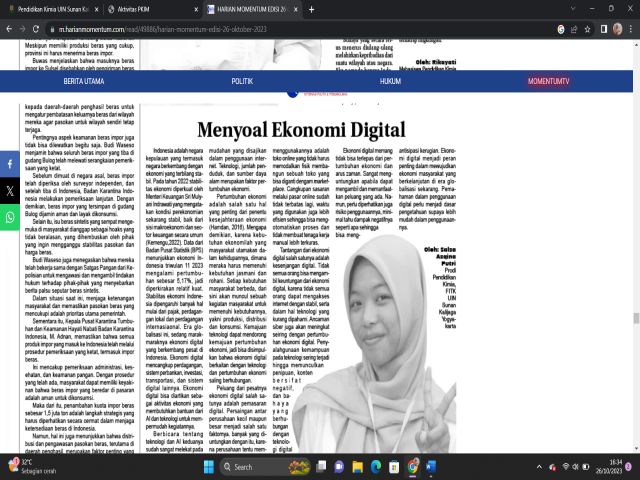
Indonesia is an archipelagic country and a developing nation with a fairly stable economy. In 2022, economic stability was reinforced by Finance Minister Sri Mulyani Indrawati, who said that the current economic condition is stable, both in terms of the macroeconomy and the financial sector in general (Kemenkeu, 2022). Data from the Central Statistics Agency (BPS) show that the Indonesian economy grew by 5.17% in the second quarter of 2023, so it is estimated to be relatively strong. Indonesia's economic stability is influenced by many things, ranging from taxes and local trade to international trade. In this era of globalisation, the digital economy is booming and growing rapidly in Indonesia. The digital economy covers trade, the banking system, investment, transportation, and other digital systems. The digital economy can be defined as economic activity that requires the help of AI and technology to make its activities easier.
Speaking of technology and AI, both are already deeply embedded in society and have even become an important necessity. The technology that has truly mushroomed is the use of the internet; who is not familiar with the internet? It is a system that makes it easier for people to carry out their activities. Currently, the number of internet users has reached 215.63 million out of a population of 275.78 million, which as a percentage exceeds 78%, according to a survey by the Indonesian Internet Service Providers Association (APJII). This is one piece of evidence that the internet has begun to be used widely, not merely for sending and receiving messages. Now it leans more towards buying and selling, because of the convenience offered by internet use. Technology, population size, and natural resources are factors of economic growth.
Economic growth is one of the important determinants of economic welfare (Hamdan, 2016). Why is that? Because economic needs are what people prioritise in their lives, as they must fulfil both physical and spiritual needs. Every person's needs differ, and from this arise community activities to meet those needs, namely production, distribution and consumption. Technological progress can drive economic growth, so it can be concluded that the digital economy is related to technology and economic growth, and that they are interconnected.
One of the opportunities of the rapidly growing digital economy is digital marketing. Competition between small and large companies is one of the factors. Many people benefit from this, because companies certainly need many job vacancies with the various skills they require. With increasing innovation, consumers do not feel bored and producers also have great opportunities in their marketing.
Ease of access and flexibility greatly benefit users; the digital economy shows economic transactions that are practical and far-reaching through the use of the internet as a medium. The digital economy has changed patterns in business, which were once done manually and have become fully automated and easy. A common example that we often come across, or even often use ourselves, is the online shop, which does not need the physical capital of building a store and can be replaced with a marketplace. The reach of the target market through online markets is no longer limited, and the time used is also more efficient, so processes can be automated and manual labour is not drained as much.
One of the challenges of the digital economy is the digital divide. Not everyone can benefit from the digital economy, because not everyone can access the internet reliably, and some lack understanding of technology. Cyber threats will also increase along with the growth of the digital economy. Misuse of technological capabilities often occurs, giving rise to fraud, negative content, and other dangers related to digital technology.
The digital economy indeed cannot be separated from economic growth and the flow of the times. It is very beneficial if one can seize and make use of the opportunities that exist. However, the risks of its use also need attention; at the very least, one should know what the negative impacts are so that losses can be anticipated. The digital economy plays an important role in realising a sustainable community economy in today's era of globalisation. An understanding of digital use needs to become a basic body of knowledge so that it is easier to use.
Comments (0)
No comments yet.