
Education Shapes the Future in Life
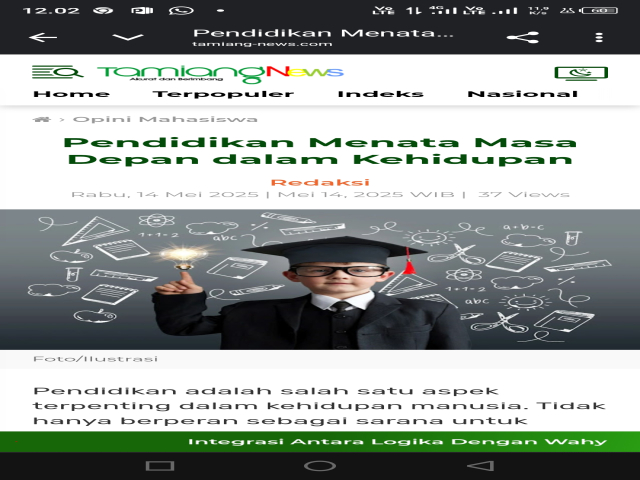
EDUCATION SHAPES THE FUTURE IN LIFE
Education is one of the most important aspects of human life. Not only does it serve as a means of acquiring knowledge, education also shapes a person’s character, mindset, and skills. In a broader context, education is the main foundation of a nation’s progress. Developed and prosperous countries generally have good and equitable education systems. Conversely, underdeveloped countries often face various problems in the education sector, from limited access to low quality.
In Indonesia, education has been a main concern of the government since independence. The Preamble of the 1945 Constitution states that one of the goals of the state is to advance the intellectual life of the nation. This shows that education is not merely an individual need, but also a shared responsibility to build a better future for the nation.
The Importance of Education in Life
Education plays a very broad role in life. Through education, a person can acquire the knowledge, skills, and moral values needed to face life’s challenges. Education also opens opportunities to improve living standards, broaden horizons, and strengthen self-confidence. One of the main benefits of education is improving the quality of human resources. Educated human resources will adapt more easily to the changing times, especially in an era of globalisation and digitalisation like today. They are able to think critically, creatively, and innovatively in facing various problems. In addition, education also plays an important role in shaping a national character that is full of integrity, tolerance, and social spirit.
Not only that, education is also the key to overcoming poverty. With good education, a person has a greater chance of getting a decent job and an adequate income. This directly affects the improvement of the welfare of families and society. Therefore, investment in education is a strategic step to break the chain of poverty and create a better life.
Types of Education in Indonesia
Education in Indonesia is generally divided into three types, namely formal, non-formal, and informal education.
Formal Education
Formal education is the best-known education pathway and is systematically structured and tiered. This education takes place in official institutions such as schools and universities that have planned curricula and certain requirements. Formal education consists of three main levels:
Basic education (elementary school, junior high school)
Secondary education (senior high school/vocational school)
Higher education (universities, academies)
Characteristics of formal education include strict rules, scheduled learning processes, qualified teaching staff, examinations as evaluation, and certificates or diplomas as proof of graduation. Formal education aims to provide academic knowledge and skills that are recognised nationally and internationally.
Non-formal Education
Non-formal education is an education pathway outside the formal system that is also structured and tiered, but more flexible in curriculum and timing. This education is usually organised by special institutions in the community, such as courses, skills training, Qur’an Education Centres (TPA), or Sunday schools.
The aim of non-formal education is to add knowledge and practical skills that are often not taught in formal schools. Non-formal learning focuses more on the independence of learners in managing their own learning process, with time that is not as strictly bound as in formal schools. Non-formal education is highly relevant for developing life skills and additional knowledge.
Informal Education
Informal education is education obtained independently in the family and community environment. For example, a child learns manners from parents, learns to cooperate with friends, or learns life skills from everyday experience.
These three types of education complement one another and play an important role in shaping whole individuals who are ready to face the challenges of the times
Challenges and Opportunities in the World of Education
Although education plays a very important role, many challenges remain in the world of education in Indonesia. One of the main challenges is the gap in access to education between urban and rural areas. Many children in remote areas still struggle to get a decent education because of limited facilities, teaching staff, and infrastructure.
In addition, the quality of education is also a serious concern. Many schools still lack quality teachers, adequate textbooks, and adequate facilities and infrastructure. A curriculum that is too dense and not relevant enough to the needs of the world of work is also a challenge in itself.
However, behind these challenges, there are great opportunities for change. The development of information and communication technology opens opportunities to expand access to education through online learning. The government and various parties also continue to strive to improve the quality of education through various programmes, such as teacher training, scholarships, and the building of educational infrastructure.
The Role of Society in Improving Education
Education is not only the responsibility of the government, but also the responsibility of the whole society. Parents, teachers, and the surrounding environment play an important role in supporting children’s education. Parents, for example, must give attention and support to children in their learning, and instil moral and ethical values from an early age.
Teachers, as the spearhead of education, must also continually improve their competence and professionalism. Inspiring and dedicated teachers will be able to arouse students’ enthusiasm for learning and create an enjoyable learning atmosphere.
In addition, society can also play an active role in supporting education through various activities, such as providing learning facilities, organising literacy activities, and giving scholarships to underprivileged children.
Recognising the importance of education, it is time for all of us to commit to supporting improvements in the quality of education in Indonesia. Education is a long-term investment whose results will be felt by future generations. With good education, we can create human resources that are excellent, competitive, and able to lead Indonesia towards a better future.
Comments (0)
No comments yet.