
Kurikulum Merdeka: A Brilliant Policy Held Back by Inequality
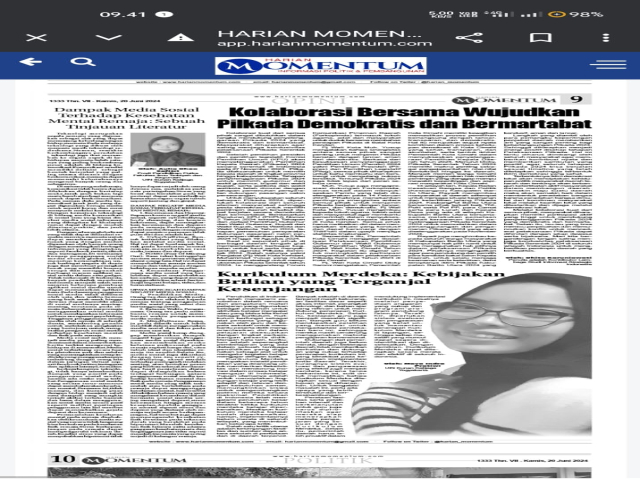
Education in Indonesia has undergone changes in the planning and arrangement of the subject matter used as a guide for teaching and learning activities, which we commonly know as the curriculum. The curriculum serves as the first tool used by teachers and school principals to help learners orient themselves in their lessons, adjusted to the learners' level of development. In other words, a curriculum is a set of learning that exists within an educational institution and is used as a tool to organise teaching and learning activities well.
The Merdeka Curriculum is an educational initiative designed to provide flexibility and encourage innovation in the teaching and learning process in Indonesia. Its main goal is to create a learning environment that is more adaptive and relevant to the needs of the times, enabling students to develop their potential to the fullest. Education in Indonesia has undergone major changes in recent years since the Merdeka Belajar curriculum was introduced. Although the Merdeka Belajar curriculum has been introduced, its implementation is not yet evenly spread across all regions, which has drawn several criticisms.
One main criticism is the gap in facilities and resources between schools in urban areas and in remote areas. Many schools in remote areas still lack basic facilities such as internet access, technological devices, and relevant teaching materials to support the implementation of the Merdeka Curriculum. In addition, teacher readiness is also a significant problem. Many teachers have not received adequate training to adapt to this new approach, so they still tend to use conventional teaching methods.
Support from local governments is also uneven, with some regions not giving enough attention and support to the implementation of this curriculum, which results in implementation gaps between regions. Finally, the lack of an effective evaluation and supervision system is also an obstacle, because without this mechanism it is difficult to ensure that the Merdeka Curriculum is implemented in line with its intended goals. To overcome these problems, more structured and sustained efforts are needed.
Equalising facilities, together with intensive and continuous training for teachers, must also be prioritised so that they are ready to apply teaching methods that fit the Merdeka Curriculum. In addition, local governments must be more proactive in supporting the implementation of this curriculum, for example by providing sufficient budgets and other supporting programmes. Finally, a strict evaluation and supervision system is needed to monitor the implementation of the Merdeka Curriculum in the field, so that any problems that arise can be identified and resolved promptly. In this way, the Merdeka Curriculum can be implemented evenly and effectively throughout Indonesia.
Comments (0)
No comments yet.