
What Is the Level of Teacher Welfare in Indonesia Today?
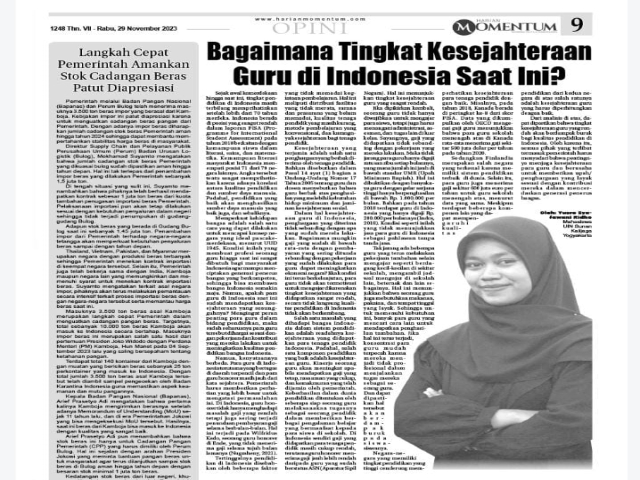
What Is the Welfare of Teachers in Indonesia Today?
From the early days of independence until now, the level of education in Indonesia is still rather concerning after more than 70 years of independence. Indonesia ranked very low in the 2018 PISA (Programme for International Student Assessment) report regarding students' abilities in literacy, science, and mathematics. Indonesians' literacy ranked 71st out of 79 other countries. This figure is certainly alarming because there is a correlation between the quality of education and human resources. After all, good education will produce good human resources as well, and vice versa.
Strengthening the life of the nation is one way to achieve the concept of an ideal post-independence state, according to the 1945 Constitution. This condition is what makes the teaching profession very much needed by Indonesian society to this day, in order to create a competent next generation that can move the Indonesian nation further forward. However, have teachers in Indonesia today actually received true welfare? Considering the important role of teachers in education, they should be appreciated in line with the work and contributions they make to improving the quality of education of the Indonesian nation.
However, the reality is different. Teachers in Indonesia, especially those serving in remote areas and honorary teachers, are still far from prosperous. The government must give greater attention to resolving this problem. In Indonesia, honorary teachers face not only the problem of low salaries but also frequent delays of salary payments for months. This happened to Wilfridus Kado, an honorary teacher in Ende, who did not receive a salary for seven months (Nugraheny, 2021).
The backwardness of education in Indonesia is caused by several factors that make learning activities inadequate. These include the uneven distribution of facilities, inadequate facilities and infrastructure, the still insufficient quality of educators, conventional learning methods, and a lack of welfare for educators.
Guaranteed welfare is one of the rewards that educators are entitled to receive. It is even stated in Article 14 paragraph (1) point a of Law Number 17 of 2005 concerning teachers and lecturers that teachers are entitled to an income above the minimum necessities of life and guarantees of social welfare.
In terms of teacher welfare in Indonesia, the rewards received are not commensurate with what they have done. How can a salary that is already below average, with payments that are often delayed, be commensurate with the work done by teachers, and be able to improve the country's economy? If this condition continues, teachers will not be motivated to teach because the level of welfare they receive is very low, and indirectly the quality of education in Indonesia will not develop.
One of the problems faced by the Indonesian nation in its education system is the low welfare received by Indonesian educators. Yet one component of good education is teacher welfare. A teacher's performance will improve if they receive a fixed salary, sufficient security, and prosperity guaranteed by the government. Success in the world of education is determined by how ready a teacher is to carry out their duties as an educator in providing various useful learning experiences to students at school. In Indonesia itself, the salaries received by educators are still quite low, especially honorary teachers, who receive salaries much lower than teachers who already have ASN (State Civil Apparatus) status. This shows a very low level of teacher welfare.
On reflection, a teacher is required not only to teach students but also to handle administration, assessment, and other tasks outside the classroom. Unfortunately, the salary they receive is not commensurate with the work they do. It is therefore not uncommon for teachers to be paid only hundreds of thousands of rupiah each month, which is far below the UMR (Regional Minimum Wage) standard. This is evidenced by the many teachers with high bachelor's degrees who earn less than Rp. 1,000,000 per month. In 2018, there were even teachers in Indonesia who were paid only Rp. 200,000 per month (Indra, 2018). It is conditions like this that fail to honour the service of teachers in Indonesia as unsung heroes.
It is not uncommon for some teachers to keep doing side jobs besides teaching, such as small-scale trading around the school, taking teaching schedules at other schools, raising livestock, and so on. This shows that a teacher also needs food, clothing, and decent housing. So, to meet these needs, many teachers look for other ways to earn additional income. If this keeps happening, teachers' concentration is easily divided because they become unprofessional in carrying out their duties as teachers. And it is certain that this will have a bad effect on their students.
Countries with high levels of education tend to look after the welfare of educators well. For example, in 2018, Canada ranked 8th in PISA scores. Data collected by the OECD on teachers' salaries show that upper secondary school teachers in Canada receive an average salary of around 590 million dollars per year in 2020.
Meanwhile, Finland is one of the countries famous for having the best education system in the world. In addition, teachers there also receive a salary of around 600 million euros per year for upper secondary school teachers, according to the same data. Although there are several other components that can affect the quality of education in the two countries above, one of them, teacher welfare, must be taken into account properly.
From the analysis above, it is certain that a low level of teacher welfare will have a bad effect on the quality of education in Indonesia. Therefore, all parties involved, including the government, must realise the importance of safeguarding teachers' welfare and strive to provide fair pay/rewards in line with their contribution to educating the nation's next generation.
Comments (0)
No comments yet.