
Blended Learning as an Educational Solution in the Pandemic Era Based on Poll Results from Various Students in Indonesia
Introduction
Indonesia is currently being hit by the corona virus, which first originated in the city of Wuhan, China. The virus spreads very quickly and has spread to almost all countries, including Indonesia. Its spread took only a few months. The corona virus (Covid-19) attacks the respiratory system, causing lung infections that can lead to death. This has led several countries to adopt lockdown policies to prevent the spread of the corona virus. In Indonesia, the Large-Scale Social Restrictions (PSBB) policy has been enforced to curb the spread of Covid-19. President Joko Widodo has urged all Indonesians to work and study at home, and even to worship at home, during the Covid-19 pandemic. As a result, activities outside the home have been disrupted by this virus.
Since the Covid-19 outbreak was declared a pandemic, and health protocols were enforced in various countries that reduced direct physical contact, many institutions have had to adjust to these circumstances. Higher education institutions are among those that have had to adjust by shifting teaching and learning activities to an online system (daring, or "in the network") without direct face-to-face contact. Online learning has become an increasingly prominent alternative amid the spread of the pandemic.
In Indonesia, the online learning system was established through Circular Letter Number 4 of 2020 on the Implementation of Education Policy during the Emergency Period of the Spread of Covid-19, issued on 24 March 2020. In the transition from the conventional learning system to online learning, students, lecturers and other learning elements were required to adapt to the change as quickly as possible. Online learning, as commonly used by schools and universities, is basically a model of teaching and learning activities carried out remotely through a network (the internet), with the help of intermediary devices such as (gadgets, laptops and smartphones). To join an online teaching and learning forum, internet access is needed as the link between the devices used by learners and teachers, as well as for exploring. Several supporting applications are available, including Google Classroom, Zoom Cloud Meetings, and some also use the e-learning media provided by the campus.
However, as we know, the online learning carried out is still less than optimal. Several things need attention, including network disruptions, limited data packages, limited finances for buying supporting gadgets, and so on.
According to Izzudin (2012:5), blended learning is basically the combined advantage of learning conducted face to face (face to face learning) and virtually (e-learning). Online learning or e-learning in blended learning becomes a natural extension of traditional classroom learning that uses the face-to-face model (face to face learning). With blended learning, we can learn interactively in a way that comes close to direct face-to-face learning, and it can also be done when students and lecturers are far apart or outside the campus. This learning can be done anywhere by arranging the study schedule according to the available time.
Based on the problems described above, blended learning can be a solution for the learning system during the pandemic. With blended learning, both online and offline learning processes can be applied. Through blended learning, access to education, and the efficiency and quality of learning and teaching, can increase. For this reason, the author attempted a survey analysis to support this opinion and to find out whether blended learning is an effective way of learning in the pandemic era.
Blended learning
At present, e-learning programmes are a hot topic in the world of education, as increasingly sophisticated technology will influence learning methods. Regulations for e-learning are also currently being drafted by the government, as stated by the Minister of Research, Technology and Higher Education, Muhammad Nasir, who said, “Regulations on the implementation of e-learning or online lectures will soon be issued by the government.”
Moving from a face-to-face model, or meeting in person, to an online (online) one takes a lot of effort and no small cost. However, this can usually be started with the blended learning model. What is blended learning?
According to Semler (2005) “Blended learning combines the best aspects of online learning, structured face-to-face activities, and real world practice. Online learning systems, classroom training, and on-the-job experience have major drawbacks by themselves. The blended learning approach uses the strengths of each to counter the others’ weaknesses.”
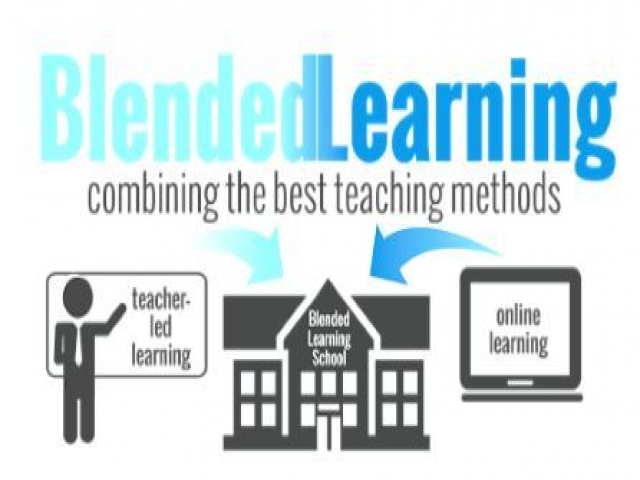
Blended learning is a learning facility that combines various delivery methods, teaching models and learning styles, introducing a variety of media for dialogue between the facilitator and the person being taught. Blended learning is also a combination of direct (face-to-face) teaching and online teaching, but more than that, it is an element of social interaction.
In implementing blended learning, especially the facilities for its online learning, teachers can make use of various services. One is a learning system that uses a Learning Management System (LMS). According to Ellis (2009: 1), an LMS is a software application for the administration, documentation, tracking, reporting and delivery of educational courses or training programmes. An LMS can be described as learning management prepared for students and teachers to carry out learning through software. LMS software that can be used includes Moodle, Canvas, Google Classroom, edmodo, Kelas Digital Rumah Belajar, blogs, and others.
These various LMS services can be used by teachers, free of charge or for a fee; they only need to learn and use them to facilitate online learning. Online learning in blended learning can be maximised by teachers so that students can learn more independently, without being tied to time and place, whenever and wherever suits the student, and this could be a solution to the limited class time that is often a complaint of some teachers in achieving learning objectives.
Blended Learning as a Learning Solution in the Pandemic Era
The Joint Decree (SKB) of four ministries on the implementation of the 2020-2021 teaching and learning process, dated 15 June 2020, set the new 2020/2021 academic year for early childhood education, primary education and secondary education to begin in July 2020. Under the SKB, face-to-face learning may only be held in education units located in the green zone. Education units in the yellow, orange and red zones are prohibited from holding face-to-face learning and must continue learning from home (BDR).
A combination of on-off learning (online and offline/face to face) has become the solution for schools during the Covid-19 pandemic. The importance of blended learning is that the teaching and learning process can keep running close to the ideal. And most importantly, it avoids learning loss during the pandemic.
Offline, or face-to-face, learning has been trialled in several schools in Indonesia. The trials showed both positive and negative sides. Besides the many positives, some problems emerged and became material for evaluation, for example how hot and uncomfortable students and teachers felt wearing face shields, masks and gloves. Because of this, it cannot be denied that face-to-face learning has become important because online (online) learning continues to meet many obstacles, for example a lack of equipment, teachers and students who have not yet fully mastered technology, student boredom, and exposure to radiation from phone or computer screens.
On-off learning, or blended learning, is the solution. Learning is done proportionally at a distance, but a space for interaction, or face-to-face contact, must also be provided. For this reason, the blended learning system must be arranged in such a way that health remains the priority, so that education and health issues can proceed together over time.
Blended learning has the following aims: to help learners develop better in the learning process in line with their learning styles and learning preferences; to provide practical and realistic opportunities for teachers and learners to learn independently, usefully and continuously; and to increase scheduling flexibility for learners, by combining the best aspects of face-to-face and online instruction. Face-to-face classes can be used to engage students in interactive experiences. Online classes, meanwhile, provide students with rich multimedia content full of knowledge at any time and anywhere, as long as the learner has internet access.
“Blended learning : An Educational Solution in the Pandemic Era?” Based on a Survey of 117 Students at Various Universities in Indonesia
To find out about and strengthen the opinion on blended learning as an educational solution in the pandemic era, the author conducted a survey of 117 students at various universities in Indonesia, consisting of students from Untirta (25 people), UMT (1 person), UPI (5 people), UNS (4 people), Unila (3 people), IPB (1 person), UGM (1 person), GUNADARMA Depok (15 people), UMJ (9 people), UNDIP (2 people), UIN Jakarta (7 people), ITERA (1 person), UIN Sunan Kalijaga (4 people), UMY (2 people), Universitas Pakuan (4 people), Poltekkes Banten (5 people), Universitas Sahid (4 people), Universitas Nusa Bangsa (2 people), UNPAM (8 people), ITL Trisakti (1 person), Universitas Budi Luhur (1 person), Universitas Pancasila (1 person), STIKES RSPAD (1 person), UNP (1 person), Universitas MUHAMMADIYAH Dr. HAMKA (1 person), STIKES WDH (1 person), Universitas Esa Unggul (4 people), and STMIK GLOBAL (3 people).
Based on the responses of these 117 students, several results were obtained. The results of the online survey illustrate the effectiveness of the blended learning method, as follows:
1. Understanding of What Blended learning Is
According to the survey results, 33.3% of students know a fair amount about blended learning from the mass media. Then, 32.5% of students know of it through the mass media and the now widespread webinars. The remaining 27.4% said they did not know it because they had never heard the term, and 6.8% know it very well through applying it themselves.
2. Poll on Holding Blended learning (a Combination of Learning Processes Both Online and Offline) on Each Student's Own Campus.
According to the survey results, 65.8% of students agreed with blended learning being carried out on campus because it makes things easier for students in learning processes that demand practice. 17.9% of them somewhat disagreed with applying two learning systems because some students live far from campus. 13.7% of students strongly agreed because it can reduce boredom, can make learning time more effective when a lecturer or some students cannot come to campus, and, for the rest, it can give better understanding because they can meet lecturers face to face and go directly into the field to carry out a laboratory practicum experiment. And the remaining 2.6% of students disagreed because the pandemic is not yet over, so it could result in the spread of the virus.
3. Poll on How Many Times Face-to-Face Blended learning Should Be Held to Be Effective Each Week
According to the survey results for this question, 39.3% of people chose face-to-face blended learning held 2-3 times/week in order to balance online and offline learning. Then, about 29.9% of students chose 1-2 times/week to reduce activities that could cause crowds. This aims to prevent the virus spreading further. 23.1% of students chose 3-4 times/week because many students have courses that require practice. Meanwhile, 7.7% of students chose every day. This is because offline learning is much more effective.
4. Poll on the Effectiveness of Blended learning
According to the survey results, 61.5% of students agreed with carrying out blended learning during the pandemic. This is because face-to-face learning with the instructor is very important so that the material given can be clearer. And 18.8% of students somewhat disagreed because the online learning process is not effective at all. 14.5% of students strongly agreed because it can give more understanding when meeting the instructor in person and when there is a laboratory practicum. Then, the remaining 5.1% disagreed because this learning method has two systems, which are certainly not easy to run at the same time. In the online system, the network, device and environment must be supportive. On the other hand, in the offline system, students must be ready with funds and facilities and infrastructure to make offline learning easier. If the two systems do not support each other, the learning process is very ineffective.
5. Obstacles in the Blended learning Process in the Pandemic Era
According to the survey results, 53.8% of people felt hindered when undergoing blended learning during the pandemic, because during online learning the signal, device and environment are often not supportive. Next, 35.9% of students felt not hindered because the distance from their residence to campus is not far. 6% of students felt not hindered at all because facilities, funds, and facilities and infrastructure were already adequate. And the remaining 4.3% of students felt very hindered. This is caused by the current situation, which is unsafe and not conducive. Health must be the priority. If our health is not well maintained, learning will also be greatly hindered.
Based on the survey results, blended learning turns out to have advantages and disadvantages. The following are the advantages and disadvantages of blended learning obtained from the survey of 117 students from various universities in Indonesia:
|
Advantages of Blended Learning |
Disadvantages of Blended Learning |
|
|
The disadvantages of blended learning itself can still be overcome with help from the government and several related parties, so that blended learning can be implemented. In this way effective learning will be obtained, and it is hoped that blended learning can become a learning solution in the pandemic era.
Conclusion
This pandemic period pushes us to adapt the learning process to a new system. Both educators and learners also adapt to online learning. However, effective education still needs to be implemented, so that Indonesia's golden generation, with each person's unique potential, can be born and together advance Indonesia. It is hoped that this Covid-19 outbreak will not only bring panic in the public sphere, but will also become a spur for the Indonesian nation, especially the government and related ministries, to concentrate fully on directing all of this year's education budget towards creating a virtual curriculum; teaching and learning processes through online technology, while preparing supporting facilities and infrastructure, the availability of internet networks, democratic and competitive management, up to the sustained involvement of the community.
All the implications presented are an orientation on the implementation of blended learning in the pandemic era. It is hoped that with cooperation from educators, learners, the government and other parties, the blended learning method of education can be implemented.
References
Ericha, W.P. Dampak Covid-19 Terhadap Kegiatan Penbelajaran Online di sebuah Perguruan Tinggi Kristen Indonesia. Jurnal Perspektif Pendidikan. 34 (1) : 1-8.
Eyoni, Maisa. 2020. “lpmpdki Kemdikbud Pembelajaran Blended Learning”. Jakarta.
Fathurrahman, & H. Nuhpaturahman. 2015. Blended Learning. Institut Agama Islam NegeriI Antasari. Banjarmasin.
Menteri Pendidikan dan Kebudayaan RI SE No. 4 Tahun 2020 Tentang Pelaksanaan Kebijakan Pendidikan dalam Masa Darurat Penyebaran Covid-19.
Surat Edaran Kemendikbud No. 4 Tahun 2020. Pelaksanaan KebijakanPendidikan dalam Masa Darurat Penyebaran Corona Viru Disease Covid 19. Diakses pada 30 Desember 2020 dari https://pusdiklat.kemdikbud.go.id/surat-edaranmendikbud-no-4-tahun-2020-tentang-pelaksanaan-kebijakan-pendidikan dalam-masa-darurat-penyebaran-corona-virus-disease-covid-1-9/
Syarif, Izzudin. 2012. “Pengaruh Model Blended Learning terhadap Motivasi dan Prestasi Belajar Siswa SMK”. Jurnal Pendidikan Vokasi, Vol 2, Nomor 2, Juni 2012. Hal 12.
Comments (0)
No comments yet.