
Caring Philanthropy: Distribution of ZIS Funds for the Darwis Education Scholarship by Lazismu Mantrijeron Yogyakarta
Education is a process of personal formation in which, through systematic education, a person's personality is shaped. Education occupies a central position in development because its target is to improve the quality of human resources (SDM). For this reason, education is also the central thread of development across all development sectors.
According to data from the Ministry of Education, Culture, Research, and Technology (Kemendikbudristek) released in May 2022, there were 75,303 children who dropped out of school in 2021. The number of dropouts at the elementary school (SD) level was the highest, at 38,716 children. The number of dropouts at the elementary level fell by 13.02 percent from the previous year, when 44,516 children dropped out at the SD level in 2020. Next, the number of dropouts at the junior high school (SMP) level was 15,042 children. This figure rose 32.20 percent from the previous year's 11,378 children. Then, 12,063 children dropped out at the vocational high school (SMK) level. This figure fell 13.53 percent compared with the previous year's 13,951 children. Meanwhile, 10,022 children dropped out at the senior high school (SMA) level. This figure fell 27.90 percent from 13,879 in 2020.
In Islam, problems such as those above can be addressed by implementing zakat, infaq, and shadaqah funds effectively. The three share a similarity in their role of making a significant contribution to poverty alleviation. The implementation carried out by zakat management institutions (amil zakat) generally covers how they utilise zakat, infaq, and shadaqah (ZIS) funds in several programmes, one of which is an educational scholarship programme intended for children with economic limitations in obtaining an education (mustahiq). One of the amil zakat institutions with a programme providing assistance in the form of educational scholarships is LAZISMU Mantrijeron.
LAZISMU is a national zakat institution devoted to community empowerment through the productive utilisation of zakat, infaq, waqf and other philanthropic funds, whether from individuals, institutions, companies or other agencies. It was founded by the Central Board of Muhammadiyah in 2002 and subsequently confirmed by the Minister of Religious Affairs of the Republic of Indonesia as a National Amil Zakat Institution through SK No. 457/21 November 2002. With the enactment of Zakat Law number 23 of 2011, Government Regulation number 14 of 2014, and Decision of the Minister of Religious Affairs of the Republic of Indonesia number 333 of 2015, LAZISMU as a national amil zakat institution was reconfirmed through SK of the Minister of Religious Affairs of the Republic of Indonesia number 730 of 2016. The background to the founding of LAZISMU consists of two factors. First, the fact that Indonesia is blanketed by widespread poverty, ignorance and a very low human development index. Second, zakat is believed to be able to contribute to promoting social justice and human development and to alleviate poverty.
LAZISMU was established as a zakat management institution with modern management that can make zakat part of the solution to continually developing social problems (problem solver). With a work culture of trustworthiness, professionalism and transparency, LAZISMU strives to develop itself into a trusted zakat institution. And over time, public trust has grown stronger.
The operational activities of LAZISMU Medan involve fundraising. Fundraising is the process of collecting voluntary contributions in the form of money or other resources by soliciting donations from individuals, companies, foundations, or government agencies. Then, from the funds collected, LAZISMU Mantrijeron distributes and utilises them in several programmes, including: education programmes, economic programmes, health programmes, social and humanitarian programmes, and da'wah programmes.
LAZISMU Mantrijeron hopes to achieve equitable and increased provision of scholarships to mustahiq every month, but in practice, up to now, several problems are still found in the field, among them:
a. The existence of LAZISMU Mantrijeron has not been maximised or made known to the public.
b. Many people still do not know that LAZISMU Mantrijeron has several programmes for distributing zakat, infaq, and shadaqah (ZIS) funds, one of which is the educational scholarship programme. The public generally thinks that zakat institutions distribute zakat, infaq, and shadaqah (ZIS) funds only in the form of basic food packages, namely food necessities given to the mustahiq.
c. The zakat, infaq, and shadaqah (ZIS) funds allocated for scholarships cannot yet meet the educational needs of the mustahiq.
d. LAZISMU Mantrijeron has not been able to accommodate the large number of scholarship applications submitted by the mustahiq.
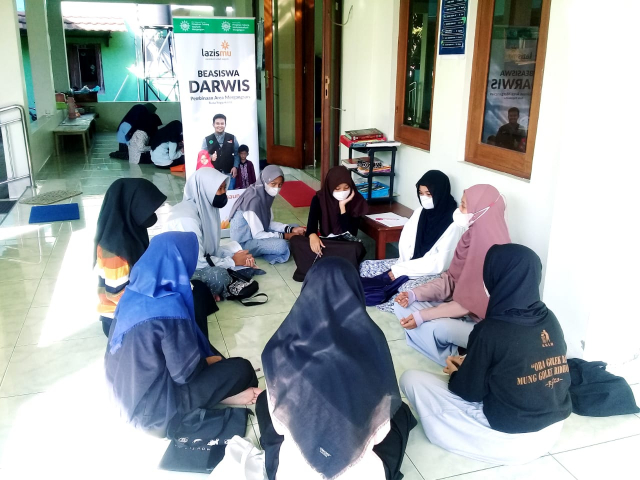
The Darwis scholarship programme is one of the work programmes of LAZISMU Mantrijeron, focusing on distributing scholarships to children from elementary school up to senior high/vocational school and on empowering Darwis scholarship children in the city of Yogyakarta. In the mentoring programme for Darwis Scholarship children, LAZISMU Mantrijeron is divided into three areas spread across the city of Yogyakarta. These areas are Mantrijeron, Mergangsan, and the Keraton area. The empowerment activities for the mentored Darwis Scholarship children consist of receiving an educational mentoring programme, guidance at each school level, and the improvement of the mentored students' soft skills and hard skills. In addition, the mentored Darwis Scholarship students are required to submit a mutaba’ah sheet, which records their obligatory and voluntary prayers.
As for the impressions of serving as a mentor, it cultivates a sense of care and awareness of social and educational problems. As a mentor, one is also expected to be a good example for the mentored students. Seeing the cheerfulness and broad smiles on the faces of the mentored students is one of the sparks of enthusiasm for the mentors to accompany them and share knowledge during the teaching and learning process. The obstacle experienced by the mentors during the Darwis scholarship mentoring is the still insufficient number of mentors, both in the Mergangsan and Mantrijeron areas, so that with the limited mentors available they have to handle a large number of Darwis Scholarship children.
In the researcher's view, the distribution of ZIS funds for educational scholarships greatly helps students from disadvantaged backgrounds (mustahiq) to continue their education like students in general. Because, fundamentally, for a nation to progress it needs outstanding Human Resources (SDM), and outstanding SDM are created and formed while people are studying at school or university. And the implementation of the distribution for educational scholarships carried out by LAZISMU Mantrijeron already fully meets the standards and does not burden the scholarship recipients (mustahiq), because it is in accordance with the deliberation and consensus of the manager, staff and the ranks of LAZISMU Mantrijeron members.
Comments (0)
No comments yet.