
Teachers Must Adapt to Generation Z and the Relationship with Teacher Professionalism
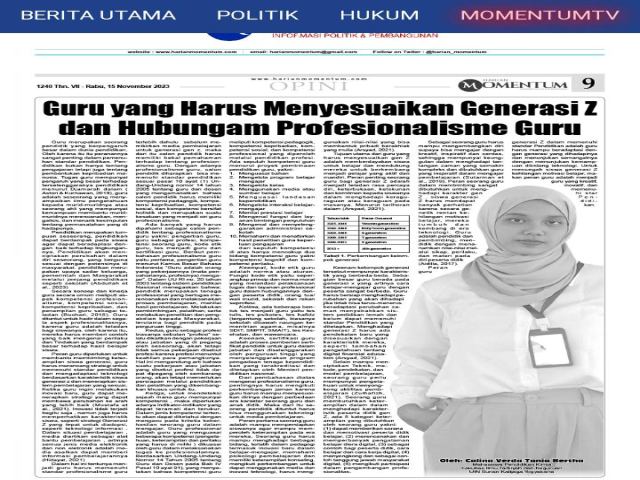
Teachers Who Must Adapt to Generation Z and the Relationship with Teacher Professionalism
By: Calina Verda Tania Bertha
Student of Chemistry Education
Faculty of Tarbiyah and Teacher Training
UIN Sunan Kalijaga Yogyakarta
A teacher is an educator with a great influence in the world of education. Therefore, the teacher's role is very important in meeting education standards. Education is not only about teaching but also about shaping human personality. The teacher's task has a great influence on the delivery of education; according to Djamarah in (Astori & Kurnawan, 2018), a teacher is someone who conveys knowledge to their students or an expert who has the ability to help their students plan, analyse, and draw conclusions about the problems they face.
Education is a person's foundation; education can affect students so that they can adapt well to their environment. Education will create change within a person that is useful according to their potential in society. Education is a conscious effort of the family, the government, and society through levels of education such as school (Abdullah et al., 2023)
In concept and performance, teachers in general encompass aspects of professional competence, social competence, personal competence, and the teacher's appearance as a role model (Buchari, 2018). Teachers are required to be present in all aspects of their professionalism, because teachers are role models for their students. Therefore, they must set a good example regarding behaviour and actions that have a great impact on students' learning outcomes.
The teacher's role is needed to help guide the skills of the student generation; teachers must design strategies to meet education standards and adapt technology based on the characteristics of Generation Z students and apply a suitable learning system. When teachers want to make a new innovation, they can apply strategies that can bring change in a better direction (Mustafa et al., 2021). Innovation does not happen just like that, but must also pay attention to students' characteristics, such as the Generation Z strategies that are appropriate to adopt, such as information technology. In a learning situation, media is defined as a learning aid, meaning that all kinds of electronic and non-electronic media are media as long as they can provide learning information (Hidayat, 2021)
In this case, of course, becoming a teacher requires first meeting the standards of teacher professionalism before thinking about learning media for Gen Z. Therefore, prospective educators must have an understanding of teacher professionalism. With teacher professionalism, prospective educators are expected to be able to meet education standards in accordance with Article 10 paragraph (1) of Law Number 14 of 2005 on teachers and lecturers, which mandates that prospective educators must have pedagogical competence, personal competence, social competence, and competence that are holistic and form a unity that characterises a professional teacher.
There is a lot that prospective educators must understand about teacher professionalism, namely: the definition of a teacher, teaching as a profession, a teacher's competence, the teacher's code of ethics, tests for becoming a teacher, and teacher certification. The following is a discussion of teacher professionalism. First, the definition of a teacher according to the Great Indonesian Dictionary (KBBI) is "A teacher is a person whose job (livelihood, profession) is teaching". Law of the Republic of Indonesia No. 20 of 2003 on the National Education System affirms that: educators are professionals who are tasked with planning and carrying out the learning process and assessing learning outcomes. Providing guidance and training, as well as conducting research and community service, especially for educators at universities.
Second, teaching as a profession: the term "profession" is usually associated with a job or position held by someone, but not every job is called a profession because a profession demands expertise from those who hold it. This means that a job or position called a profession cannot be held by just anyone, but requires preparation through education and training developed specifically for it.
Third, to detect the extent to which a teacher has competence, observable and measurable indicators are needed. A certain type of competence can be identified by referring to the criteria of a teacher's success in teaching. A professional teacher is a teacher who masters several competencies (knowledge, skills, and behaviours that must be possessed) mastered by the teacher in carrying out their professional duties. Based on Law Number 14 of 2005 on Teachers and Lecturers, Chapter IV Article 10 paragraph 91), which states that teacher competence includes pedagogical competence, personal competence, social competence, and professional competence obtained through professional education. There are ten teacher competencies according to the teacher education development project, namely:
- Mastering the subject matter
- Managing the teaching and learning programme
- Managing the class
- Using media or learning resources
- Mastering the foundations of education
- Managing teaching-learning interaction
- Assessing learning achievement
- Knowing the functions and services of guidance and counselling
- Knowing and carrying out school administration
- Understanding and interpreting research results for teaching purposes
The ten competencies above cover only two areas of teacher competence, namely cognitive competence and behavioural competence.
Fourth, the teacher's code of ethics is a norm or rule. The function of the code of ethics is a set of moral principles and norms that underlie the carrying out of teachers' professional duties and services in their relationships with learners, parents/guardians, schools, and fellow professionals.
Fifth, there are several forms of tests for becoming a teacher, namely a written test, a psychological test, a Quran memorisation (hafidz) test (depending on the school, usually schools under the Ministry of Religious Affairs, for example SDIT, SMPIT, SMAIT), a health test, and an interview.
Sixth, teacher certification is the process of awarding an educator certificate to in-service teachers, organised by universities that run accredited programmes for providing education personnel and designated by the Minister of National Education.
From the discussion above on teacher professionalism, it is important to keep up with the times because teachers must be able to adjust themselves to the differences in era between the character of a teacher and that of their students. Therefore, an educator is required to be able to use technology as a learning medium.
A teacher's first role is to be able to prepare their students to acquire the skills of their era. A teacher must be able to handle various fields, be trained in pedagogy including new innovations in teaching and learning, understand the psychology of learning and have counselling skills, keep up with developments in order to use media and technological innovation, and must apply values that can shape a person of noble character (Arsyad, 2021).
The main aim of teachers who must adapt to Gen Z is to empower students to learn and support them to grow into active and independent learners. An important role of a teacher for Generation Z is to be a role model of confidence, openness, perseverance, and commitment to their students in facing doubt or hesitation in their time. According to Tarihoran in (Arsyad, 2021).
|
Year of birth |
Generation name |
|
1925-1946 |
Veteran generation |
|
1946-1960 |
Baby boom generation |
|
1960-1980 |
X generation |
|
1980-1995 |
Y generation |
|
1995-2021 |
Z generation |
|
2012 + |
Alfa generation |
Table 1. Development of generation groups
These six generation groups have different characteristics. Most teachers belong to Generation X, which means that the teachers' way of teaching and learning is very different from that of their students. Teachers must be prepared to face the changes ahead; if they cannot continuously adapt, changes of the times will weaken the education system and it will not be able to meet the established education standards. Facing Generation Z requires a new approach adapted to their characteristics, such as additional knowledge about digital financial education (Arsyad, 2021).
Besides being able to create techniques, methods, approaches, and learning models, a teacher needs to have knowledge to support learning activities (Zulhafizh, 2021). A teacher needs skills in dealing with the characteristics of Gen Z learners; there are 5 categories of skills a teacher needs, namely: (1) being able to provide facilities and motivate learners to learn, (2) planning and expanding learning experiences in the digital era, (3) being a model for learners of digital ways of learning and working, (4) supporting and modelling the responsibilities of a digital society, (5) taking part in professional development.
A teacher must be able to develop themselves so as to teach creatively, inspiringly, and intelligently, so that they have an advantage in facing the increasingly complex challenges of the times, and inspiring teachers are needed in teaching (Sutarman et al., 2019). The teacher's role in guiding is greatly needed to deal with the character of Gen Z. Generation Z students need to receive a lot of attention because they are genetically prone to losing motivation to learn, as they grow and develop in the technological era. A teacher is an educator and guide, educating by instilling values through attitude, behaviour, and material in learners (Aidilla, 2017).
The role of teachers of Generation Z in meeting education standards is that teachers must be able to adapt to the generation they face and show their enthusiasm by demonstrating ability in the field of technology. To prevent Generation Z students from losing motivation to learn, the teacher's role is to be a creative, innovative teacher who meets education standards.
Comments (0)
No comments yet.