
When Schools No Longer Know Home
When Schools No Longer Know Home
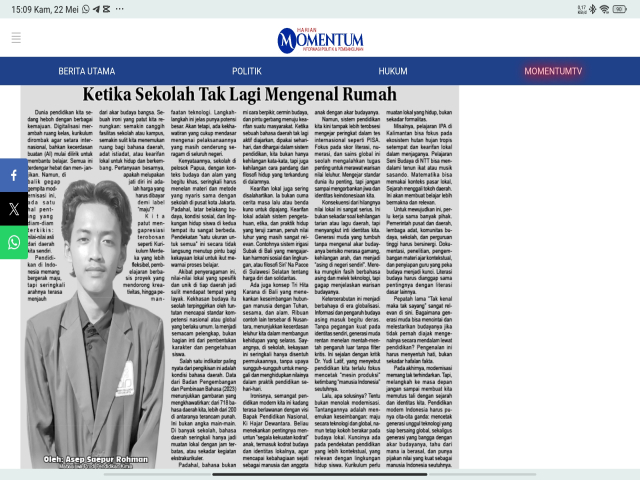
By: Asep Saepur Rohman
Student of the Chemistry Education Study Programme
Faculty of Tarbiyah and Teacher Training
UIN Sunan Kalijaga Yogyakarta
Our world of education is buzzing with all kinds of progress. Digitalisation is entering classrooms, curricula are being overhauled to match international standards, and even artificial intelligence (AI) is starting to be considered as an aid for learning. All of this sounds great and promising. Yet, behind the fanfare of modernisation, one important thing is quietly being eroded: the original values of our own regions.
Education in Indonesia is indeed moving forward, but its direction often feels like it is drifting away from the nation's cultural roots. It is an irony worth reflecting on: the more sophisticated the facilities of a school or campus, the harder it is to find room for regional languages, customs, or local wisdom to live and grow. The big question is, is forgetting this identity the price that must be paid for the label of being "advanced"?
We should appreciate breakthroughs such as the more flexible Merdeka Curriculum, project-based learning that encourages creativity, and the use of technology. These steps clearly have great potential. However, there is a fairly fundamental concern about their implementation, which still tends to be uniform across the country.
In reality, schools in remote parts of Papua, with their very distinctive cultural and natural context, often have to swallow materials and methods that are nearly identical to those of schools in central Jakarta. Yet the cultural backgrounds, social conditions, and living environments of students in the two places are very different. This "one size fits all" approach indirectly closes the door to local richness taking part in colouring the learning process.
As a result of this uniformity, the specific and unique local values of each region find it hard to get the place they deserve. Cultural distinctiveness seems to be pushed aside by the demand to achieve generally applicable national or global competency standards. It becomes a kind of accessory, not a core part of shaping students' character and knowledge.
One of the clearest indicators of this erosion is the condition of regional languages. Data from the Language Development and Fostering Agency (2023) show an alarming picture: of our 718 regional languages, more than 200 are endangered. This is not a trivial figure. In many schools, regional languages are often only a local content subject with limited hours, or merely an extracurricular activity.
Yet language is not merely a tool of communication. It is a window to understanding ways of thinking, a mirror of culture, and a gateway to a community's wisdom. When a regional language is no longer actively taught, used in daily life, and valued in the education system, we lose not only words, but also the perspective and philosophy of life contained within them.
Local wisdom is also often misunderstood. It is not just stories of the past or ancient objects to be displayed. Local wisdom is a system of knowledge, ethics, and life practices that has stood the test of time, full of noble values that remain highly relevant. Examples include the Subak irrigation system in Bali, which teaches social and environmental harmony, or the philosophy of Siri’ Na Pacce in South Sulawesi about self-respect and solidarity.
There is also the Tri Hita Karana concept in Bali, which emphasises balance in the relationships between humans and God, fellow humans, and nature. Thousands of other examples are scattered across the archipelago, showing the intelligence of our ancestors in building harmonious lives. Unfortunately, in schools this richness is often only touched on the surface, without a sincere effort to explore it and bring its values to life in everyday educational practice.
Ironically, the spirit of our modern education sometimes feels contrary to the vision of the Father of National Education, Ki Hajar Dewantara. He stressed the importance of guiding "all the natural forces" of the child, including their cultural nature and local identity, so as to attain true happiness as a human being and a member of society. True education must align the child's potential with their cultural roots.
However, our education system now appears more obsessed with chasing rankings in international tests such as PISA. This focus on global literacy, numeracy, and science scores seems to override the important task of caring for the heritage of our ancestors' values. Pursuing world standards is important, but we must not sacrifice the soul and identity of being Indonesian.
The consequences of losing local values are very serious. This is not merely about losing regional dances or songs, but concerns the core of our identity. Young people who grow up without knowing their cultural roots risk feeling lost, losing direction, and becoming "strangers in their own land". They may be fluent in foreign languages and tech-savvy, but stammer when explaining their cultural heritage.
This uprooting becomes dangerous in the era of globalisation. Information and foreign cultural influences pour in so fast. Without a firm grip on their own identity, young people are vulnerable to swallowing outside influences whole, without a critical filter. This is in line with the criticism of Dr. Yudi Latif, who said that our education focuses too much on producing "production machines" rather than complete "Indonesian human beings".
So, what is the solution? Certainly not rejecting modernisation. The challenge is to find a balance: advancing technologically and globally, yet remaining firmly rooted in local culture. The key lies in a more contextual approach to education, one that is relevant to students' living environments. The curriculum needs to give schools real room to develop living local content, not just a formality.
For example, science lessons in Kalimantan could focus on the local tropical rainforest ecosystem and the local wisdom in protecting it. Cultural Arts lessons in NTT could delve into ikat weaving or sasando music. Mathematics could use the context of local markets, and History could explore regional figures. This would make learning more meaningful and relevant.
To realise this, cooperation among many parties is needed. The central and regional governments, customary institutions, cultural communities, schools, and universities must work in synergy. Documentation, research, the development of contextual teaching materials, and the preparation of culturally sensitive teachers are key. Cultural literacy must be regarded as just as important as other basic literacies.
The old proverb "You cannot love what you do not know" is very relevant here. How can young people love and preserve their culture if they have never been invited to know it deeply through education? This introduction must touch the heart, not be mere memorisation of facts.
In the end, modernisation is indeed unavoidable. But stepping into the future must not make us sever our ties with our history and identity. Modern Indonesian education must have a dual ideal: producing a technologically excellent generation that is ready to compete globally, and at the same time a generation that is proud of its cultural roots, knows where it comes from, and has a strong foothold of values as complete Indonesian human beings. That is true progress.
Comments (0)
No comments yet.