
Tracing Detergent in Yogyakarta's Rivers: An Eye-Opening Internship Experience
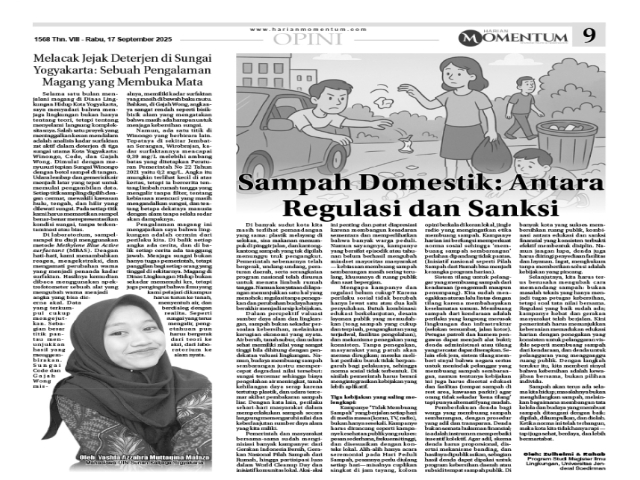
During one month of an internship at the Yogyakarta City Environment Office, I realised that protecting the environment is not only about theory, but about directly immersing oneself in its complexity. One project that left a deep impression was the analysis of the level of surfactants, the active substance in detergents, in three main rivers of Yogyakarta City: Winongo, Code, and Gajah Wong. It began with walking along the bank of the Winongo River with a sample bottle in hand. The humid air and the murmur of the water were the right backdrop for starting data collection. Each sampling point was chosen carefully, representing the upstream, middle, and downstream areas the river passes through. At every point we had to ensure that the sample truly represented the condition of the river, without contamination or bias.
In the laboratory, the samples were tested using the Methylene Blue Active Surfactant (MBAS) method. Carefully, we added reagents, extracted, and observed the colour change that marks the surfactant level. The results were then read using a spectrophotometer, a device that turns colour into numbers the mind can digest. The data collected were quite surprising. Most monitoring points showed encouraging results. The Code and Gajah Wong rivers, for example, had surfactant levels still below the quality standard. In fact, in Gajah Wong the figure was so low, like a whisper of nature saying that there is still hope for keeping the river clean.
However, one point on the Winongo told a different story. Specifically, around Serangan Bridge, Wirobrajan, the surfactant level reached 0.39 mg/L, exceeding the threshold set by Government Regulation No. 22 of 2021, which is 0.2 mg/L. The figure may look small on paper, but it tells of household waste flowing without filters, of washing habits that still rely on the river, and of how close humans are to nature without always being aware of the impact.
This internship taught me that the environment is a mirror of our behaviour. Behind every number there is a story, and behind every story there is responsibility. Protecting the river is not only the government's duty, but a calling for everyone who lives around it. The internship at the Environment Office was not merely fulfilling a study-plan (KRS) requirement, but also a reminder that the knowledge we learn on campus must come down to earth, touch the water, and engage in dialogue with reality. Like a river that keeps flowing, knowledge must also move from theory to action, from the laboratory to the real world.
Comments (0)
No comments yet.