
Cultivating Children's Traditional Games
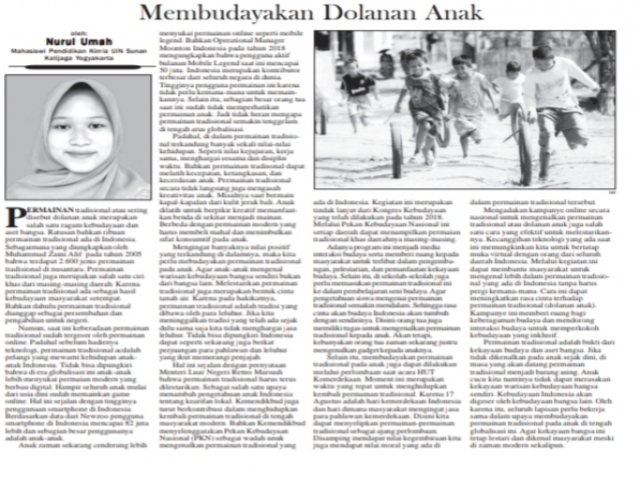
Traditional games, often called dolanan anak (children's games), are one of the varieties of culture and an asset of the nation. Hundreds, even thousands, of traditional games exist in Indonesia. As stated by Muhammad Zaini Alif in 2005, there are 2,600 types of traditional games in the archipelago. Traditional games are also a distinctive feature of each region, because they exist as a product of the local community's culture. In the past, traditional games were even regarded as an offering and a service to the country.
However, today the existence of traditional games has been displaced by online games. Yet before technology arrived, traditional games were the rainbow that coloured the lives of Indonesian children. It cannot be denied that in this era of globalisation children prefer modern, digital games. Almost all children, even from an early age, already play online games. This is in line with the high use of smartphones in Indonesia. According to data from Newzoo, smartphone users in Indonesia number more than 82 million, and most of the users are children.
Children today tend to prefer online games such as Mobile Legends. In 2018, the Operational Manager of Moonton Indonesia even stated that Mobile Legends now has 50 million monthly active users, with Indonesia the largest contributor of all countries in the world. The high number of users of this game is because there is no need to go anywhere to play it. In addition, most parents today no longer pay attention to their children's games. So it is no wonder that traditional games are increasingly sinking in the current of globalisation.
Yet traditional games contain a great many life values, such as honesty, cooperation, respect for others and time discipline. Traditional games can even train children's speed, agility and intelligence. Traditional games also indirectly sharpen children's creativity. For example, when playing with a toy boat made from a pomelo peel, children are trained to think creatively and to turn objects around them into toys. This differs from modern games, which have to be bought at a high price and instil consumerist tendencies in children.
Considering the many positive values contained in them, we need to make traditional games part of children's culture, so that children get to know the cultural heritage of their own nation rather than that of other nations. Preserving traditional games is also a form of love for the homeland, because in essence traditional games are traditions handed down by our ancestors. If we abandon traditions that have existed since long ago, it is the same as not honouring the services of our ancestors. It cannot be denied that Indonesia is what it is today also thanks to the struggle of the heroes and ancestors who fought the colonisers.
This is in line with the statement of Foreign Minister Retno Marsudi that traditional games must continue to be preserved, as one effort to increase Indonesian children's knowledge of local wisdom. The Ministry of Education and Culture (Kemendikbud) has also contributed to reviving traditional games in modern society. Kemendikbud even organises the National Culture Week (Pekan Kebudayaan Nasional, PKN) as a forum for introducing the traditional games that exist in Indonesia. This activity is a follow-up to the Culture Congress held in 2018. Through this National Culture Week, every region can showcase the traditional games typical of its own area.
This programme serves as a medium for cultural interaction and gives the public space to take part in developing, preserving and making use of cultural wealth. In addition, schools also need to include these traditional games in arts and culture lessons, so that students' knowledge of traditional games grows deeper and love for Indonesian culture grows of its own accord. Here parents also have the duty to introduce traditional games to their children. However, most parents today instead introduce gadgets to their children.
In addition, making traditional games part of children's culture can also be done through competitions during Independence Day celebrations. This moment is the right time to revive traditional games, because 17 August is Indonesia's Independence Day and the day when people remember the services of the independence heroes. Here we can slip traditional games in as competitions. Besides the joy, we also gain the moral values found in those traditional games.
Holding a nationwide online campaign to introduce traditional games, or dolanan anak, is also an effective way to preserve them. Today's technological sophistication allows us to meet virtually, face to face, with people from all regions of Indonesia. Through this activity, people can be helped to learn more deeply about the traditional games that exist in Indonesia without having to go anywhere. This approach can increase love for traditional games (dolanan anak). The campaign makes room for cultural diversity and encourages cultural interaction to strengthen an inclusive culture.
Traditional games are proof of cultural wealth and a national asset. If they are not introduced to children from an early age, in the future traditional games will become foreign objects. Our grandchildren will not be able to experience the wealth of their own nation's cultural heritage. Indonesian culture will be displaced by the cultures of other nations. Therefore, all levels of society need to work together in the effort to make traditional games part of children's culture amid this globalisation, so that the nation's wealth remains preserved and known to the public even in modern times.
Newspaper: Mata Banua
Link : https://matabanua.co.id/2021/09/23/e-paper-harian-pagi-mata-banua-kamis-23-september-2021/
Comments (0)
No comments yet.