
Responding to the Hoax News on KRI Nanggala-402 from the Tweet of the @AndiPitopang6 Account
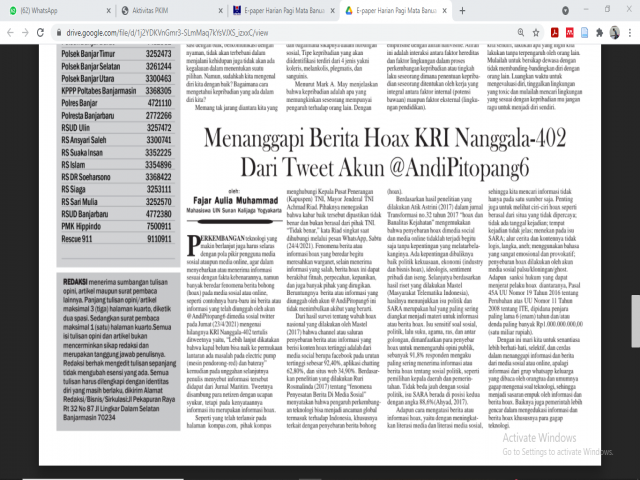
Ever-advancing technology must also be matched by the mindset of social media and online media users, so that information is spread or received in accordance with the truth. However, the phenomenon of fake news (hoax) circulates widely on social or online media. An example is news or information recently uploaded by the account @AndiPitopang6 on the social media platform Twitter on Friday (23/4/2021) about the missing KRI Nanggala-402, which said in the tweet, “It was further said that the ship could not rise to the surface because of problems with the electric pump (propulsion engine - ed.) and battery”. In a subsequent post the author said the information came from Jurnal Maritim. The tweet was followed by netizens with expressions of gratitude, but in reality the information was hoax information.
As reported on the kompas.com page, Kompas contacted the Head of the TNI Information Centre (Kapuspen), Major General TNI Achmad Riad. He stressed that the good news was confirmed to be untrue and did not come from the TNI. "It is not true," Riad said briefly when contacted via WhatsApp message, Saturday (24/4/2021). The phenomenon of hoax news or information circulating is very unsettling to netizens; besides receiving wrong information, hoax news can result in slander, division, panic, and harm to many parties. Fortunately, the news or information uploaded by the account @AndiPitopang6 did not cause any significant consequences.
A survey on the national hoax epidemic conducted by Mastel (2017) found that the channel for spreading news or information containing hoax content with the highest share was social media, with Facebook at the top at 92.40%, chat applications at 62.80%, and websites at 34.90%. Research by Ruri Rosmalinda (2017) on “The Phenomenon of Misleading News on Social Media” states that the influence of technological development can become a global threat, including to Indonesia, especially in relation to the spread of fake news (hoax).
Research by Atik Astrini (2017) in Jurnal Transformasi no. 32 of 2017, “Hoax and the Banality of Evil”, argues that the spread of hoaxes on social and online media does not happen by chance without underlying interests. There are interests behind it, whether political power, economic (the hoax industry and business), ideological, personal sentiment, or just for fun. Furthermore, research by Mastel (Indonesian Telematics Society) shows that political and SARA issues (ethnicity, religion, race and inter-group relations) are the most frequently used as material for hoax information or news. Sensitive issues of social affairs, politics, and ethnicity, religion, race and inter-group relations are exploited by hoax spreaders to influence public opinion; 91.8% of respondents admitted that they most often receive hoax information or news about social politics, such as regional head elections and government. Not far behind social politics, SARA issues are in second place at 88.6% (Ahyad, 2017).
As for ways to deal with hoax news or information, namely by improving media literacy and social media literacy, so that we look for information from more than just one source. It is also important to look at the characteristics of hoaxes such as coming from an untrustworthy site; no date of the event; unclear location of the event; stressing SARA issues; an illogical, rare or strange storyline and content; use of very emotional and provocative language; and hoax spreading done by fake/cloned/ghost social media accounts. As for the legal sanctions that can ensnare hoax perpetrators, they include Article 45A of Law Number 19 of 2016 concerning Amendments to Law Number 11 of 2008 concerning ITE (Electronic Information and Transactions), with imprisonment of up to 6 (six) years and/or a fine of up to Rp1,000,000,000.00 (one billion rupiah).
With this, let us always be more careful, selective and smart in responding to information and news from social or online media, especially information from family WhatsApp groups that is read by parents who are generally unfamiliar with technology, making them easy targets for hoax information and news. It would also be good for the government to be more active in educating about hoax information and news, especially for those who are not tech-savvy.
Newspaper name: Mata Banua
Link: https://drive.google.com/file/d/1zjVPtAaglAjJ8ad0PiZDmchIimlthhjR/view?usp=drivesdk
Comments (0)
No comments yet.