
The Importance of the Character of Honesty
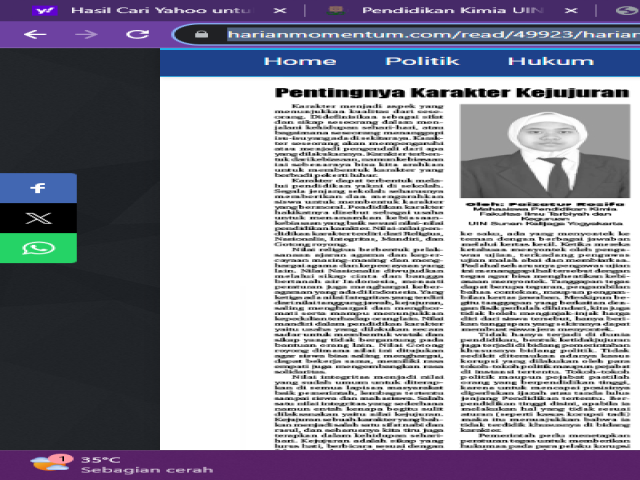
Character is an aspect that shows the quality of a person. It is defined as a person's nature and attitude in going about daily life, or how a person responds to the issues around them. A person's character will influence or control what they do. Character is formed from habits, but these habits can in fact be directed so that we form a character of noble moral conduct.
Character can be formed through education, namely at school. All levels of schooling should give and direct students towards forming a moral character. Character education is essentially defined as an effort to instil good habits in accordance with the values of character education. The values of character education consist of Religiosity, Nationalism, Integrity, Independence, and Mutual cooperation (gotong royong).
The value of religiosity takes the form of practising the teachings of one's own religion and beliefs while respecting other religions and beliefs. The value of nationalism is expressed through love and pride for the Indonesian homeland, obeying rules, and respecting the diversity found in Indonesia. Third is the value of integrity, which consists of the values of responsibility, honesty, mutual respect, and the ability to show care for others. The value of independence in character education is a consciously made effort to form a character and attitude that does not depend on the help of others. The value of mutual cooperation (gotong royong) is intended so that students can respect one another, work together, have a sense of empathy, and also develop a sense of solidarity.
The value of integrity is a value that is commonly applied at all levels of society, from the government and certain institutions to school and university students. One value of integrity that is simple yet, for some reason, so hard to practise is the value of honesty. Honesty is a character trait that is even one of the qualities of the prophets and messengers, and we should also imitate it and apply it in daily life. Honesty is an upright attitude, speaking in accordance with facts, and acting according to the rules.
In reality, in daily life, many people deviate from honest behaviour. A small example in the world of education, especially in schools, is that many students still cheat during exams. This is a form of deviation because, under exam rules, students are forbidden to cooperate with one another so that the competence of each student can be known. Yet many students cheat in order to get high marks.
Cheating takes many forms: some hide books in their desk drawers, some put smartphones in their pockets, and some cheat from friends by passing various answers on small pieces of paper. When they are caught cheating by the exam invigilator, the invigilator sometimes ignores it and lets it go. In fact, the invigilator should respond firmly in order to stop the habit of cheating. A firm response can take the form of a reprimand, confiscating the cheat material, or taking away the answer sheet. Even so, responses involving physical action should be avoided, and we must not trample on the student's dignity; only give a response that is likely to make students afraid to cheat again.
Dishonesty does not occur only in the world of education; it also occurs in government, especially in politics. Quite a few cases of corruption have been found, committed by political figures and officials in certain institutions. Political figures and officials are surely highly educated people, because reaching their positions requires a diploma or proof of graduating from a certain level of education. If someone who is highly educated does something that is against the rules (such as the corruption cases mentioned above), it shows that he or she is not educated, especially in the area of character.
The government needs to set firm regulations to impose punishment on perpetrators of such corruption, because corruption is very harmful to the people and the state. The punishment given should at least deter the perpetrators and serve as an example for others not to do the same.
Given the many deviations of dishonest behaviour, all sections of society, as well as the government and educators, need to work together to ensure that the character of honesty is increasingly applied in daily life. Firm rules need to be applied to everyone who violates them, which also aims to make others stay away from rule-breaking behaviour. All of this is for the sake of building the nation's character with high-quality human resources.
Comments (0)
No comments yet.