
PPG: Improving Teacher Quality or Just a Formality? Who Is Responsible?
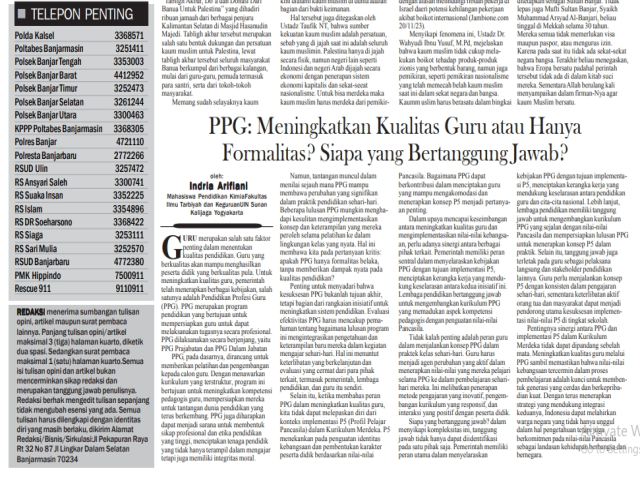
Teachers are one of the important factors in determining the quality of education. Quality teachers will be able to produce quality learners as well. To improve teacher quality, the government has implemented various policies, one of which is the Teacher Professional Education (PPG). PPG is an education programme that aims to prepare teachers to carry out their duties professionally. PPG is carried out in stages, namely Pre-service PPG and In-service PPG
PPG is, at its core, designed to provide training and development to prospective teachers. By offering a structured curriculum, the programme aims to improve teachers' pedagogical competence and prepare them for the challenges of an ever-evolving world of education. PPG is also expected to be a means of forming a professional attitude and high educational ethics, creating educators who are not only skilled at teaching but also have moral integrity.
However, a challenge arises in assessing the extent to which PPG is able to bring significant change to everyday educational practice. Some PPG graduates may face difficulties in implementing the concepts and skills they gained during training in a real classroom environment. This brings us to a critical question: is PPG merely a formality, without any real impact on the quality of education?
It is important to realise that the success of PPG is not the final goal, but part of a series of initiatives to improve the education system. Evaluating the effectiveness of PPG must include an understanding of how graduates of this programme integrate their new knowledge and skills into their daily teaching activities. This demands continuous involvement and careful evaluation from the parties concerned, including the government, educational institutions, and teachers themselves.
In addition, when discussing the role of PPG in improving teacher quality, we cannot detach ourselves from the context of implementing P5 (Pancasila Student Profile) in the Merdeka Curriculum. P5 emphasises strengthening national identity and forming learners' character based on Pancasila values. How PPG can contribute to creating teachers who are able to accommodate and apply the P5 concept is an important question.
In the effort to achieve a balance between improving teacher quality and implementing national values, synergy among the various related parties is needed. The government has a central role in aligning PPG policy with the goal of implementing P5, creating a framework that supports harmony between these two initiatives. Educational institutions are responsible for developing a PPG curriculum that combines aspects of pedagogical competence with strengthening Pancasila values.
No less important is the role of teachers in carrying out the PPG concept in everyday classroom practice. Teachers must become active agents of change in applying the values they learned during PPG to their daily teaching. This involves applying innovative teaching methods, developing a responsive curriculum, and positive interaction with learners.
Who is responsible? In facing this complexity, responsibility cannot be identified with just one party. The government has the main role in aligning PPG policy with the goal of implementing P5, creating a framework that supports harmony between teacher education and national ideals. Furthermore, educational institutions have the responsibility to develop a PPG curriculum in line with Pancasila values and to prepare PPG graduates to apply the P5 concept in practice. In addition, responsibility also lies with teachers as direct implementers and with other education stakeholders. Teachers need to carry out the P5 concept consistently in their daily teaching, while the active involvement of parents and the community can be a main driver of the successful implementation of P5 values at school level.
The importance of synergy between PPG and the implementation of P5 in the Merdeka Curriculum cannot be underestimated. Improving teacher quality through PPG while ensuring that national values are reflected in the learning process is the key to forming a generation that is intelligent and strong in character. By continuing to apply strategies that support the integration of the two, Indonesia can produce citizens who are not only superior in knowledge but also committed to Pancasila values as the foundation of national and state life.
Comments (0)
No comments yet.