
UTBK and the Shadow of Cheating
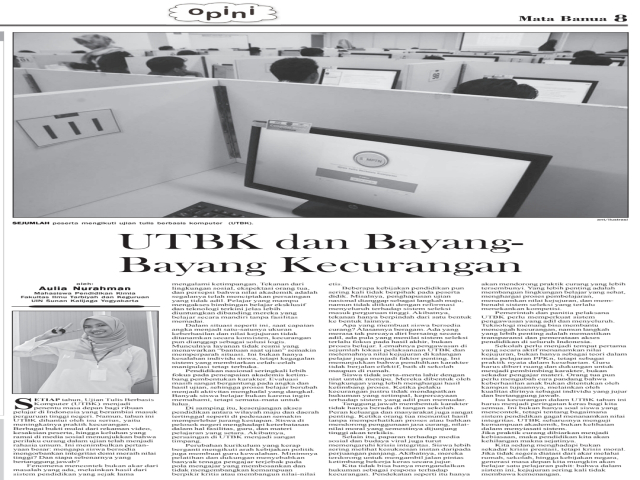
UTBK and the Shadow of Cheating
newspaper link: https://matabanua.co.id/2025/05/06/jemaah-calon-haji/
By: Aulia Nurahman
Chemistry Education Student
Faculty of Tarbiyah and Teacher Training
UIN Sunan Kalijaga Yogyakarta
Every year, the Computer-Based Written Examination (UTBK) determines the future of thousands of students in Indonesia who aspire to enter state universities. This year, however, the UTBK is haunted by a serious issue: the rising practice of cheating. Evidence ranging from video recordings and testimonies from participants to complaints widely shared on social media shows that cheating in the exam has become an open secret. This raises a big question: why are students willing to sacrifice their integrity to get high scores? And who is actually responsible?
The phenomenon of cheating is not the root of the problem, but the result of an education system that has long suffered from inequality. Pressure from the social environment, parental expectations, and the perception that academic scores are everything have created unfair competition. Students who can access exclusive tutoring and the latest technology are clearly at an advantage compared to those who study independently without adequate facilities.
In such a situation, where numerical achievement becomes the only measure of success and the value of honesty is not instilled consistently, cheating comes to be seen as a logical solution. The emergence of unofficial services offering "help during the exam" makes the situation even worse. This is not only the fault of individual students, but a failure of a system that leaves loopholes for manipulation open.
National education often focuses more on academic achievement than on character building. Evaluation still relies heavily on scores and exam results, so that learning turns into a shallow activity of memorisation. Many students study not because they want to understand, but merely to pass.
In addition, the gap in access to education between developed regions and underdeveloped areas, such as rural areas, further widens the gap in readiness. Students in remote parts of the country face limitations in facilities, teachers, and equivalent learning materials. As a result, competition in the UTBK becomes very uneven.
Curriculum changes that frequently follow the direction of political policy also overwhelm teachers. The lack of training and support leaves many teaching staff trapped in boring teaching patterns that neither develop critical thinking skills nor build ethical values.
Some education policies also often do not favour learners. For example, the abolition of the national examination was regarded as a step forward, but it was not followed by a comprehensive reform of the university entrance selection system. As a result, the pressure merely shifts from one form to another.
What makes students willing to cheat? The reasons vary. Some feel unconfident about competing fairly, while others judge that the selection system focuses too much on the final result rather than on the learning process. Weak supervision at a number of UTBK venues and the weakening value of honesty among students are also important factors. This shows that character education is not running effectively, either at school or at home.
Students are not simply born with the intention to deceive. They are shaped by an environment that values results more than process. When cheaters do not receive appropriate punishment, trust in a fair system fades.
The responsibility for shaping character does not rest with schools alone. The role of families and society is also very important. When parents demand results without paying attention to the process, or even encourage the use of cheating services, the moral values that should be upheld will erode.
Moreover, exposure to social media and viral culture also contributes to the integrity crisis. Students more often see instant success than long struggle. As a result, they are driven to take shortcuts rather than work hard honestly.
We cannot rely only on punishment as a response to cheating. Such an approach will only push cheating into more hidden forms. What matters more is building a healthy learning environment, valuing the learning process, instilling the value of honesty, and fixing a selection system that overemphasises competition.
The government and the UTBK organising committee need to strengthen a fair and comprehensive supervision system. Technology can indeed help prevent cheating, but a more important step is ensuring transparency and equal access to education across Indonesia.
Schools need to be the first place that actively instils the value of honesty, not only as theory in the Pancasila and Citizenship Education (PPKn) subject, but as real practice in daily life. Teachers must be given space and support to become character mentors, not merely deliverers of subject matter. Parents also need to change their view that a child's success is not determined by the university they attend, but by their quality as an honest and responsible individual.
The issue of cheating in this year's UTBK must be a stern warning for all of us. This is not only about students who cheat, but about how the education system has failed to instil the value of integrity. The UTBK should test academic ability, not cleverness in gaming the system. If cheating is allowed to become a habit, our education will lose its true meaning.
We are facing not merely a crisis of achievement, but a moral crisis. If it is not addressed at its roots soon, through the home, the school, and state policy, our future generations may learn one bitter lesson: that in this system, honesty often does not bring victory.
Comments (0)
No comments yet.